
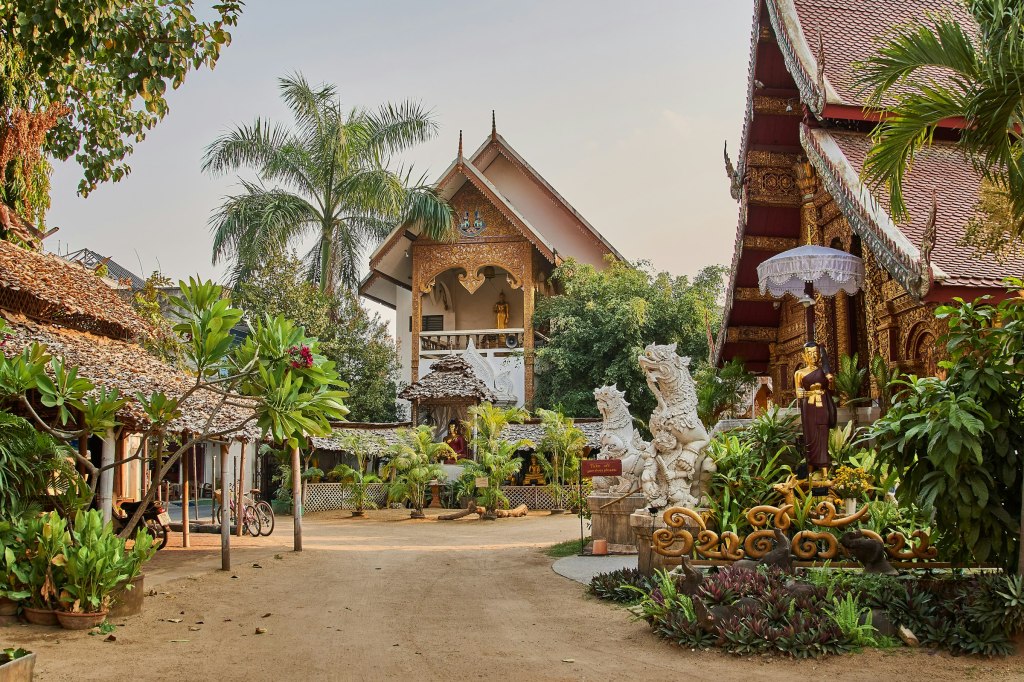
One morning inside the old city moat can span seven centuries of Lanna history, and the finest temples in Chiang Mai sit close enough to walk between. This guide to temple hopping in Chiang Mai’s old city links four of them on foot: a teak hall that began life as a royal residence, a great brick chedi, the home of the Lion Buddha, and the city’s first monastery with its ring of elephants. It then adds a fifth by songthaew, a forest sanctuary laced with tunnels. For every stop you’ll find what to look at first, what it typically costs, and how to step on to the next.
Wat Phan Tao: A Teak Hall With a Royal Past
Begin at Wat Phan Tao on Phra Pokklao Road, beside its famous neighbor, and go early while the light is low and the courtyard is calm. The viharn is built entirely of teak panels set on a stone base, and the timber carries a story. It came from a ruler’s hall raised in 1846 and was reassembled here in 1876 as a monastery building, which is why it feels more like a house than a hall.
Look above the door for the peacock and the small dog, a nod to the zodiac sign of the Chiang Mai king who lived in the original palace. Inside, red-painted teak pillars rise into a dim, honey-colored ceiling hung with long woven banners, and a golden seated Buddha faces the entrance. Admission is generally free, with posted hours of roughly 8 a.m. to 5 p.m. Confirm at the gate, as hours can shift.
Wat Chedi Luang: The Great Chedi and the Monk Chat
A few steps away, Wat Chedi Luang holds the city’s largest silhouette. Its chedi dates to the 15th century and is recorded as once rising more than 80 meters. What remains is a vast, weathered brick form, partly open to the sky, and the best way to take it in is to walk the full perimeter slowly, noticing how the stone steps and seated figures change with the angle of the sun.
The temple carries civic meaning too. Chiang Mai’s city pillar, the Inthakin, was moved here in 1800 under King Kawila, and the Inthakin festival, held around May or June, fills the grounds with offerings and prayer. Inside the viharn, look for the standing Buddha known as Phra Chao Attarot. Historians also place the Emerald Buddha here for a time before it traveled onward.
The grounds host one of the city’s best-known monk chat programs. Monks sit along the north side of the complex during the day, glad to talk with visitors about Buddhism and monastic life while practicing their English. Foreign visitors usually pay a ticket of about 40 to 50 baht at the window near the chedi (small bills, cash), and hours are posted at the gate, so check before planning an evening visit.
Wat Phra Singh: Murals, the Lion Buddha and a Lotus Pond
Wat Phra Singh anchors the western side of the old city, and it is the most layered of the group. Work began on its chedi in 1345, when King Phayu built it to hold the ashes of his father, King Kham Fu. The temple took its name after the Phra Singh, or Lion Buddha, image arrived in 1367. That image rests in the small Viharn Lai Kham, a jewel of northern Thai architecture, with a roof that sweeps low like folded wings, a black lacquer and gilt pediment, and a naga balustrade on the stairs.
Inside, murals show Jataka tales beside scenes of Lanna dress and village life, and the colors reward a slow look. Every Songkran, the image is carried through the streets in a procession, with onlookers sprinkling water over it as a blessing. Nearby, the Ho Trai, the scripture library, stands on a stone plinth. The larger Viharn Luang has bright white pillars and a gilded Buddha called Phra Chao Thong Tip.
Two details are easy to miss. A pavilion at the back holds a reclining Buddha, and the lotus pond is one of only a couple among the old city temples. The main grounds are generally free to enter, while a hall or two may ask for a small fee of around 20 to 50 baht. On Sunday afternoons the lane outside fills with market stalls.
Wat Chiang Man: The City’s First Temple
Walk east to the northeast corner of the old city, between Phra Pokklao Soi 13 and Ratchaphakhinai Road, and you reach Wat Chiang Man. It is described as the city’s oldest temple, founded around 1296 by King Mengrai, who is said to have camped on this spot while Chiang Mai took shape. The Chedi Chang Lom is the oldest structure, a square base carrying the front halves of 15 life-sized elephants that appear to bear the upper levels on their backs.
Two treasures sit in the smaller viharn. The Phra Sae Tang Khamani, or Crystal Buddha, stands about ten centimeters tall and is carved from clear quartz. Beside it is the Phra Sila, a stone relief of the Buddha taming the elephant Nalagiri, traditionally associated with bringing rain. In the larger hall, a standing Buddha inscribed with the year 1465 is described as the oldest dated Buddha image in the city. Entry is generally free, and the temple tends to be peaceful.
Wat Umong: Tunnels in the Forest
For a change of rhythm, head west to the foothills of Doi Suthep and Wat Umong, a forest monastery founded in 1297. Its signature feature is a network of brick tunnels beneath an artificial mound, where small Buddha images glow in the half dark. Local legend says a respected monk, Thera Chan, used them for quiet meditation, and the king came to consult him.
The tunnels, an ancient chedi and a lawn of old trees make the grounds feel entirely different from the city temples, and in the rainy season moss softens the stone to a deep green. It remains an active monastery with resident monks, reopened as a meditation center in the late 1940s. Admission is free, with donations welcome, and dress should cover shoulders and knees.
Planning Your Chiang Mai Temples Route
Start with Wat Phan Tao and Wat Chedi Luang at opening, walk west to Wat Phra Singh for late morning, then cross to Wat Chiang Man before lunch. Allow about 45 minutes at each, and an hour at Wat Phra Singh if the murals hold you. Wat Umong suits the afternoon: a songthaew, taxi or ride-hailing car from the old city takes roughly 15 to 20 minutes. The cool season, from about November to February, is the most comfortable time for walking between stops.
Dress modestly, remove shoes before entering halls, and carry a few small bills for tickets and offerings. If you’re planning a longer stay, the Chiang Mai travel guide shows how temples fit among the city’s tables and markets, and our list of luxury hotels in Chiang Mai helps you choose a base. For an evening version of the same streets, see the Yi Peng and Loy Krathong festival guide. Opening hours and fees can change, so a quick check at each gate is always sensible.

