
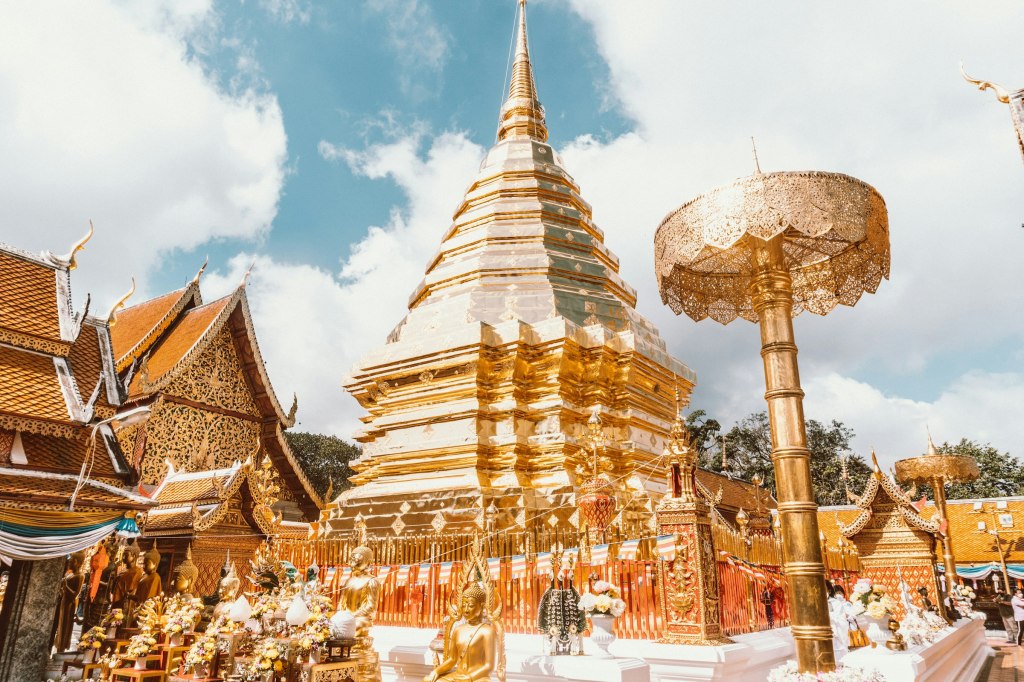
This Chiang Mai travel guide is for the traveler who wants mornings among teak temples, long lunches over a bowl of curried noodles, and evenings that end with a lantern or a massage. Chiang Mai sits in a mountain-ringed valley in northern Thailand, and it moves at a gentler pace than the capital. Below you’ll find where to stay, what to eat, what the temples cost to enter, how to get around, and a realistic price guide in baht with approximate US dollar figures.
Prices last updated October 2026. Figures use roughly 34 baht to the US dollar. Rates move with the season and the exchange rate, and the official websites of hotels, temples and operators always have the final word.
Quick facts
- Currency: Thai baht (THB), about 34 to US$1 at the time of writing.
- Language: Thai, with northern Thai (Kham Mueang) spoken locally. English is widely understood in hotels, cafes and cooking schools.
- Plugs: Types A, B, C and O; the voltage is 220 V. Bring a universal adapter.
- Airport: Chiang Mai International (CNX) sits about 3 km from the Old City. A fixed-fare airport taxi is typically about 150 to 200 baht (US$4 to $6), and a Grab car to an Old City address is about 120 to 200 baht.
- Time zone: UTC+7, no daylight saving.
- Best months: November to February.
When to go
Come between November and February. Mornings are cool enough for a light layer, afternoons are dry and sunny, and the hills outside town turn crisp and clear. It is also lantern season. Hotel rates in these months commonly run 30 to 50 percent above the rainy-season level, so book early.
March to May is warm, ideal for pools and early starts. June to October brings green rice terraces and softer room rates, and an umbrella in your bag.
Loy Krathong falls on November 25, 2026, and Yi Peng, the northern Thai lantern festival, is celebrated alongside it. Tiny floating baskets drift down the Ping River, and paper lanterns rise over the Old City. Many locals release a krathong from the banks near the Nawarat and Iron bridges, where vendors sell small lanterns for about 30 baht (under US$1). Ticketed lantern-release events outside the city exist too, with prices that vary widely, so check current details before booking. Official lantern-release windows are brief, so follow the local schedule.
Chiang Mai travel guide: where to stay
Two neighborhoods suit most first visits. The Old City, inside the square moat, puts you within walking distance of Wat Phra Singh, Wat Chedi Luang and the Sunday market. Nimman, to the northwest, is the quarter of cafes, design shops and quiet lanes off Nimmanhaemin Road. For resort calm, look to the Mae Rim valley and the paddies east of town.
| Hotel | Area | Approx. nightly rate |
|---|---|---|
| Kokotel Chiang Mai Nimman | Nimman | from about 1,550 baht (US$46) |
| 99 The Heritage Hotel | Old City | from about 3,000 baht (US$88) |
| Art Mai Gallery Nimman Hotel | Nimman | about 3,200 to 4,200 baht (US$95 to $124) |
| 137 Pillars House | Near Wat Gate, by the Ping River | about 15,000 to 22,000 baht (US$445 to $650) |
| Dhara Dhevi Chiang Mai | Sankampaeng Road, east of the Old City | from about 16,000 baht (US$470) |
| Anantara Chiang Mai Resort | Riverside | from about 21,000 baht (US$620) |
| Four Seasons Resort Chiang Mai | Mae Rim valley | from about 26,000 baht (US$770) |
137 Pillars House is a restored teak residence from the colonial era, with a small, hushed feel and a short ride to the Night Bazaar. Dhara Dhevi spreads across a 60-acre estate of Lanna-style villas and rice paddies, with buggies to carry you between them; its spa is being rebuilt after a renovation, so confirm treatments before you book. Four Seasons sits among terraced paddies about 30 to 40 minutes from the center and suits a slow, resort-led stay.
Where to eat and drink
Start with khao soi, the northern signature: egg noodles in a coconut-curry broth, topped with crisp fried noodles, with pickled mustard greens and lime on the side. At neighborhood shops a bowl generally costs about 40 to 80 baht (US$1.20 to $2.40). Khao Soi Khun Yai, on Sri Poom Road in the Old City, is a long-loved lunch address. It has traditionally opened around 10 am to 2 pm and closed on Sundays, so check before you walk over.
Look next for sai ua (herbal northern sausage), nam prik ong (a tomato and pork dip with vegetables) and gaeng hang lay (a gently sweet pork curry). A street-food meal rarely tops 75 baht, and a whole day of stall eating can come in under 300 baht (about US$9).
For coffee, Nimman has the densest choice. Ristr8to on Soi 3 is known for latte art, Roast8ry on Soi 17 opens from 8 am, and Ombra Caffe has a leafy garden. In the Old City, Akha Ama on Rachadamnoen Road and the small GRAPH Cafe on Rajvithi Lane reward a slow, careful cup. Iced Thai coffee or tea runs about 40 to 60 baht at local shops, and specialty cafes charge more. For a polished dinner, fine dining in Bangkok offers a good companion read if you’re continuing south.
Temples and what to see
Wat Phra That Doi Suthep crowns the mountain west of town, reached by a staircase of about 300 steps flanked by naga serpents (free), or by a funicular for roughly 20 to 30 baht. Foreign-visitor entry to the terrace has been reported at about 30 to 50 baht, and the temple opens daily from early morning to evening. Go late afternoon for soft light on the gold chedi, and look out over the city.
Wat Phra Singh, on the western end of Ratchadamnoen Road, is the Old City’s grandest working temple, with its Lanna-style chapel and mural-lined walls. The grounds are listed as free to enter. Wat Chedi Luang holds the ruined brick chedi that once towered over the city; entry is about 50 baht (US$1.50). Dress with shoulders and knees covered. Sarongs can be rented at the gate for around 50 baht.
On Monday, Wednesday and Friday evenings, Wat Suan Dok has typically hosted Monk Chat, a relaxed hour to speak with novices about life in the monastery. Confirm the schedule locally.
Night bazaars and markets
The Sunday Walking Street runs along Ratchadamnoen Road from about 4 pm to 10 pm, beginning at Tha Phae Gate. Arrive around 4:30 for the best stalls: hand-dyed cottons, silver, woodwork and plates of grilled northern sausage. On Saturdays, the Wualai Walking Street takes over the silversmith district just south of the moat, with the same hours. The Night Bazaar on Chang Khlan Road opens nightly from about 5 pm to 11 pm, with food courts at Kalare and Anusarn. Bargain with a smile; a friendly offer usually meets one in return. For crafts at an elevated level, see our guide to Cambodian silk and artisan shopping in Siem Reap.
Elephants, cooking classes and spas
Chiang Mai’s sanctuary culture is a highlight, and the thoughtful approach is observation, not riding. Elephant Nature Park offers a single-day visit for about 3,500 baht (US$103), including hotel transfer, a vegetarian buffet lunch, a guide and time walking alongside rescued elephants. Pickup is around 8 am and you return by about 4:30 pm. Book several days ahead.
Cooking classes are among the best-value mornings in town. A half-day class with a market visit typically costs about 750 to 1,200 baht (US$22 to $35), and full-day organic-farm courses run about 1,200 to 2,000 baht (US$35 to $59). Asia Scenic, Smart Cook and Baan Thai teach in the Old City, while Thai Farm Cooking School and Smile Organic Farm are in the Mae Rim countryside. Booking directly is often a little cheaper than through an agent.
Massage here is a pleasure at every budget. A one-hour Thai massage costs about 250 to 700 baht (US$7 to $21) at neighborhood and mid-range shops; Fah Lanna Spa lists one hour at about 700 baht. The Oasis Spa is a Lanna-style retreat where a two-hour Thai massage is about 1,700 baht (US$50), and its small number of rooms makes advance booking wise. Hotel spas at the luxury resorts offer longer rituals at higher rates.
Getting around
The red songthaew is the classic way to cross town. Within the city a shared ride is about 30 baht per person, and you simply flag one, tell the driver your destination and agree the fare before you climb in. To Doi Suthep, shared trucks from the zoo stand charge about 40 baht each way and depart when full. A private charter from the city is about 500 to 600 baht.
Grab is easy and the fare is shown upfront. Old City to Nimman costs about 60 to 100 baht (US$2 to $3); a car to the Doi Suthep area runs about 250 to 400 baht. Airport taxis use a counter fare, and the walkable Old City is best explored on foot or by bicycle.
A short itinerary
- Day one: Wat Phra Singh and Wat Chedi Luang in the morning, khao soi for lunch, a massage, then the Sunday or Wualai market.
- Day two: A cooking class with a market visit, an afternoon at a Nimman cafe, and sunset at Doi Suthep.
- Day three: A full day with the elephants at the sanctuary, then a candlelit dinner and a river stroll.
Practical tips
- Tipping: Not required, but rounding up a fare or leaving 50 to 100 baht after a massage is appreciated.
- Entry: Visa-free stays for many passports have recently been updated to 30 or 60 days depending on nationality. Check the official foreign ministry list, and complete the free Thailand Digital Arrival Card within 72 hours before arrival.
- Connectivity: A week-long tourist eSIM often costs around US$10 to $15; local SIMs are sold at the airport.
- Etiquette: Remove shoes at temple halls, and greet with a light wai. Women should not touch monks, and a polite step aside is the usual courtesy.
- Lantern rules: Release lanterns only within official windows, as local rules are firm and carry large fines.
Daily price guide
| Style | Per day | What it covers |
|---|---|---|
| Budget | about 1,500 to 2,500 baht (US$45 to $75) | Guesthouse, street food, songthaew, one temple |
| Comfortable | about 4,500 to 8,000 baht (US$130 to $235) | Boutique hotel, restaurant meals, a class or massage |
| Luxury | about 18,000 baht and up (US$530+) | Five-star resort, sanctuary day, spa, private driver |
Prices last updated October 2026. Treat every figure as a guide, and check the venue before you go. If Thailand’s capital is also on your route, our Bangkok travel guide covers riverside stays and temple mornings, and the lantern light of Hoi An makes a lovely next chapter in Vietnam.
Insider tips
Walk the Old City at first light, when monks collect alms and the air is cool. Book the sanctuary and the cooking class early in the high season. Eat lunch where the locals queue. Carry small notes of 20, 50 and 100 baht for temples, songthaews and markets.

