
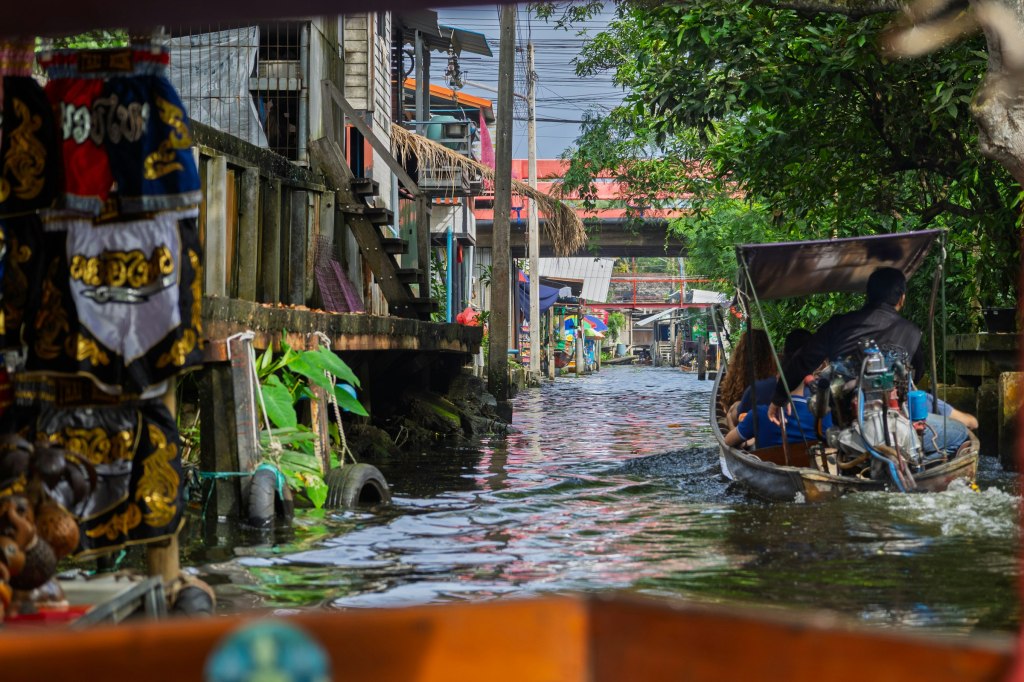
An Amphawa day trip from Bangkok suits the traveler who is happy to let a morning bend around a train timetable. In one loop you can watch a market fold itself away for a locomotive, step into a temple held together by banyan roots, walk the garden where a Thai king was born and finish on a canal where cooks serve dinner from boats. Samut Songkhram is Thailand’s smallest province, so everything below sits within easy reach, and the plan works as a long day or, better, an overnight. The one fixed point is the floating market, which opens only Friday through Sunday, so build the rest around it.
Maeklong Railway Market, Where the Awnings Fold Back
Begin in Samut Songkhram town, where the Maeklong Railway Market, called Talat Rom Hup in Thai, spreads along an active line beside Mae Klong station. Produce, fresh fish and dried seafood sit right against the rails. When a train approaches, vendors draw in their canopies and tilt their trays back, the engine rolls through at a slow walking pace, and the awnings open again behind it as if nothing had happened. Recent timetables list four arrivals at Mae Klong station, at about 8:30 a.m., 11:10 a.m., 2:30 p.m. and 5:40 p.m., with four departures toward Ban Laem at about 6:20 a.m., 9:00 a.m., 11:30 a.m. and 3:30 p.m.
Between trains, the market rewards a slow stroll. It was established in 1905, before the railway arrived, and it still feels like a working neighborhood pantry: grilled skewers, fried banana, mango with sticky rice and fresh coconut water are all easy to find. Times can shift, so confirm the day’s schedule locally or on the State Railway of Thailand timetable before you plan around a particular pass.
Wat Bang Kung and the Temple Held by Roots
About 12 kilometers (roughly 8 miles) from Amphawa, in Bang Khonthi district, Wat Bang Kung is one of the province’s most photographed temples. Its Ayutthaya-period ordination hall has been embraced over the centuries by the roots of four kinds of trees, bodhi and banyan among them, and those roots now help hold the walls steady. Inside, the principal Buddha image, known as Luang Pho Nil Manee, is covered in gold leaf added by visitors, and a mural tells episodes from the Buddha’s life.
History sits close by. In the 1760s the site served as a military camp for Siamese forces facing Burma, and the grounds hold sculptures and a memorial statue of King Taksin recalling the Battle of Bang Kung. The Fine Arts Department registered the temple as a national archaeological site in 1996. Listings generally give daily hours from about 8 a.m. to late afternoon, so aim to arrive while the light is still good.
King Rama II Memorial Park, Amphawa’s Calm Royal Garden
Amphawa proper is where the story turns to royal heritage. King Rama II Memorial Park stands on the ground where the second Chakri king was born, laid out as a shaded campus of traditional central Thai houses. The museum buildings show early Rattanakosin objects such as Benjarong porcelain, Khon masks and shadow-puppet figures, with rooms furnished to show how men and women lived and a period kitchen and bathroom. A garden planted with trees named in classical Thai literature, an open-air amphitheater for Khon performances and a riverside pavilion with the royal barge Prapas Utayan complete the grounds, and a small pavilion near the entrance is devoted to Thai desserts. The park lists daily hours of 8:30 a.m. to 5 p.m.; one listing mentions a Wednesday closure, so a quick check before you go is wise.
Wat Amphawan Chetiyaram at the Canal’s Mouth
Next door, Wat Amphawan Chetiyaram is a royal temple tied to the same family story. A Khmer-style prang rises on the site of Rama II’s birthplace and holds royal relics, with a statue of the king standing in front. The ordination hall dates from the first reign and is built in classic Thai style, while the vihara, from the third reign, shows a Chinese-influenced hand. Lonely Planet places the temple a few steps from Amphawa’s central footbridge, which makes it an easy pause between the park and the market. One recent listing notes that conservation work on the prang is scheduled to continue into 2027, so a scaffold or two may appear in your photographs.
Amphawa Floating Market and the Canal at Dusk
By late afternoon, walk to the water. Amphawa Floating Market is a Friday-to-Sunday affair, and published hours vary a little, starting anywhere from around midday to 2 p.m. and winding down at about 8 or 9 p.m. Wooden shophouses line the canal, a footbridge arches over the middle, and cooks work from moored boats, grilling seafood and handing up mango sticky rice or coconut ice cream served in the shell. A shared boat makes a slow loop of the canal, and private charters are available if you prefer your own pace.
After dark, firefly trips leave from the market dock, usually between 6 and 7 p.m. and lasting about an hour. Sightings are most dependable in the rainy months, roughly May to October, so ask the boatman what the evening is likely to bring. For a quieter detour earlier in the day, the Amphawa Chaipattananurak project, an agricultural demonstration farm reached through the Chan Chala cafe on the canal, shows how coconut sap is simmered into sugar at its Tao Tan stove station.
Where to Stay in Amphawa
If you would rather wake beside the water than head back after dark, Baan Amphawa Resort & Spa sits on the Mae Klong River at 22 Bangkapom-Kaewfah Road. The grounds include two pools, the Suphannika Spa, bicycles for guests and a Thai restaurant, Sabannga, and the room mix has been described as including pool villas and a traditional wooden rice barge. The railway market is about a 15-minute drive away, and the Chaipattananurak farm is around 3 kilometers off. Canal-side homestays in old teak houses near the market suit travelers who like a more intimate setting. Either way, a night in Amphawa lets you catch an 8:30 a.m. train at Mae Klong before the afternoon market begins.
Planning an Amphawa Day Trip From Bangkok
Choose a Friday, Saturday or Sunday, and leave Bangkok early; the drive is roughly 80 kilometers (about 50 miles) and typically takes 1.5 to 2 hours. Minivans run to Samut Songkhram from Victory Monument, and from there a local songthaew reaches Amphawa. A private driver can follow Rama II Road (Highway 35). For a more scenic route, take the Wongwian Yai to Mahachai train, cross the river by boat to Ban Laem and ride the short line to Mae Klong for a nominal fare.
A sequence that flows well: the 8:30 a.m. or 11:10 a.m. train at Maeklong market, lunch in town, Wat Bang Kung in the early afternoon, then Rama II Park and Wat Amphawan Chetiyaram before they close, leaving the canal for golden hour and a firefly boat. Pair it with a few nights in the capital using our Bangkok travel guide for 2026, and if you have time for another early start, a day in Ayutthaya’s old royal city makes a fine companion. The Yaowarat food route in Bangkok’s Chinatown is a lovely way to spend the evening before or after.
Carry small bills for market stalls, cover shoulders and knees for the temples, and pack insect repellent for the evening boats.

