
Sukhothai Historical Park is best met on two wheels, early in the day, with nowhere particular to be. This guide lays out a bicycle route through six places in a sensible order, explains what you are looking at in each, and closes with the practical details that make the day easy: tickets, rentals, timing and getting there. Sukhothai was the capital of the first Kingdom of Siam in the 13th and 14th centuries, and the old city was inscribed by UNESCO in 1991. The ruins spread across roughly 70 square kilometers, which is exactly why a bicycle suits them so well.
Why Sukhothai Historical Park suits a bicycle
The terrain is flat, the central zone is compact, and the lanes between temples are shaded by old trees. The walled old city forms a rectangle about two kilometers from east to west and 1.6 kilometers from north to south, with a gate at the center of each wall. Inside it you can link the main monuments in a gentle loop. Bicycles are rented from small shops near the main entrance, across from the Ramkhamhaeng National Museum, and many guesthouses in Old Sukhothai arrange them too. Take a minute to test the brakes and the tires before you set off; it is the kind of small habit that keeps a long morning pleasant.
Wat Mahathat: begin at the heart of the old city
Wat Mahathat, the “temple of the great relic,” is the largest and most important monument in the park, and the natural place to start. It was laid out like a mandala. A principal chedi shaped like a lotus bud, the form that became a signature of Sukhothai architecture, rises at the center, ringed by eight smaller stupas. The four at the corners follow a Mon and Lanna style, while the four between them show Khmer influence. Look closely at the base of the main chedi and you will find 168 stucco figures of disciples walking with their hands pressed together in greeting. Two standing Buddhas, each about nine meters tall, flank the chedi, and rows of seated Buddhas gather in the ruined assembly hall. Walk the full circuit rather than stopping at the first great image; the smaller stupas around the edges repay a slower look.
Wat Traphang Ngoen: a pause beside the Silver Lake
Just behind Wat Mahathat, Wat Traphang Ngoen sits beside a lagoon whose name means Silver Lake. Its main chedi, about ten meters tall, is another closed lotus bud on a square laterite base, with standing Buddha images set into niches facing the four directions. The temple is oriented so that both the rising and the setting sun light it, and the shade from nearby trees makes it a good place to slow down. Its ordination hall once stood on an island in the water, a separation that symbolized purity. Today you will see foundation bricks and column fragments there, which makes the lake itself the main attraction: still, bright and framed by ruins.
Wat Sa Si: a temple on an island
Ride north and west of Wat Mahathat, close to the King Ramkhamhaeng Monument, and you reach Wat Sa Si, set on an island in the Traphang Trakuan pond. A narrow footbridge carries you across. The main chedi is bell-shaped in the Sri Lankan style, a reminder of the Sri Lankan Buddhist tradition that shaped Sukhothai’s religious life, and a seated Buddha faces the approach. Guides to the central zone also point out a walking Buddha figure here, an image especially associated with Sukhothai art. Lotus leaves float on the water in season. Many visitors count this as the most photogenic corner of the park, so give it unhurried minutes, and look back across the pond toward the chedi from the far bank before you leave.
Wat Si Sawai: three prangs with older roots
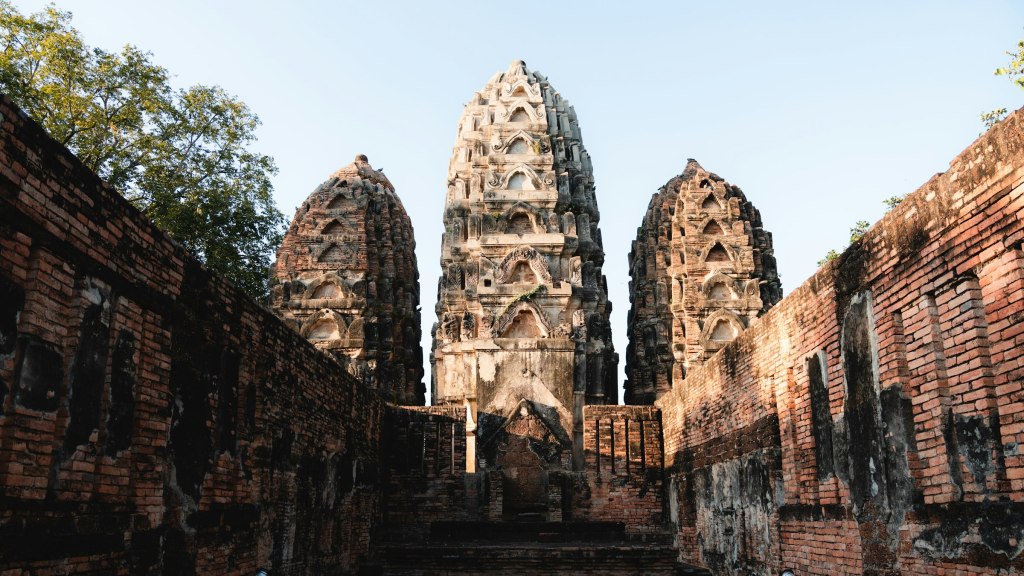
South of Wat Mahathat, near the southern gate of the old city, Wat Si Sawai tells a different story. Three laterite prangs stand inside a double rampart and a moat. The lower parts are Khmer work, while the upper levels were extended by Thai builders in brick and stucco. The site appears to have begun in the late 12th or early 13th century as a Hindu shrine, probably devoted to Vishnu, and was later adapted for Buddhist use around the 14th century. That layering is the reason to come: in one compact complex you can read the shift from one tradition to the next. It is a short, rewarding stop on the way to or from the museum.
Wat Si Chum: the great Buddha of the north zone
Just outside the moated city, in the north zone, Wat Si Chum is the image many travelers remember longest. A square mandapa about 32 meters on each side rises with thick brick walls, and inside sits Phra Achana, a stucco Buddha roughly 11 meters wide and 15 meters high in the Subduing Mara posture. The roof has fallen away, so the walls frame a patch of open sky above. Built in the late 14th century, the hall is said to have a hidden passage in its wall, and a well-loved legend holds that a king once spoke through it to encourage his soldiers, who believed they were hearing the Buddha. The passage held more than fifty engraved slate slabs of Jataka scenes, though access is limited for safety, so enjoy the story from the floor of the hall. The Buddha faces east, which makes early morning the finest hour to visit.
Wat Saphan Hin: a slate path to the hilltop
If you have energy and time, the west zone offers a change of pace. Wat Saphan Hin, “stone bridge monastery,” crowns a hill about 200 meters above the plain, and a slate pathway and staircase lead up to it, which is where the name comes from. At the top stands a large standing Buddha, about 12.5 meters tall, known as Phra Attharot. Tradition links the temple to the monk invited by King Ramkhamhaeng from the south to serve as the kingdom’s Sangharaja. The climb along the slate is gentle in spirit but real in effort, so carry water and wear shoes with grip. From the top, the plain of Sukhothai opens out below you, and the Buddha looks out over it.
Ramkhamhaeng National Museum: a cool midday stop
Near the main entrance, the Ramkhamhaeng National Museum opened in 1964 and is a branch of the National Museum of Thailand. Its collection brings the ruins into focus: Buddha images and Hindu deity sculptures from Wat Phra Phai Luang and Wat Mahathat, stucco fragments, artifacts from the 14th and 15th centuries, and Chinese porcelain recovered in excavations at Sukhothai and Si Satchanalai. It has a separate ticket from the park zones. Visit it around midday, when the sun is highest, then return to the monuments with the context fresh in your mind. Small eateries beside the bicycle shops across the road make a simple lunch easy.
How to plan your Sukhothai day
- Season: November through February is generally the most comfortable time to visit, with cooler mornings. Sukhothai also hosts a well-known Loy Krathong celebration, usually in November; check the dates before you book rooms.
- Tickets: The central, north and west zones are ticketed separately, and a combination ticket may be offered. Published prices differ between sources and have changed in recent years, so confirm the current rates and opening hours at the gate.
- Route: For the best light at Wat Si Chum, ride there first in the morning, then return to the central zone for Wat Mahathat, Wat Traphang Ngoen, Wat Sa Si and Wat Si Sawai. Save the museum for midday and Wat Saphan Hin for a second morning if you can.
- Stay: Old Sukhothai has guesthouses and cafes close to the park. Many travelers suggest two to three nights, which leaves room for the outer zones and for Si Satchanalai, a separate part of the same UNESCO property with its own entrance.
- Getting there: The park lies about 12 kilometers west of New Sukhothai, and songthaews run between the two. A small airport near Sawankhalok serves visitors, and Sukhothai can also be reached by road from Bangkok; check current schedules.
- Comfort: Bring a hat, sunscreen and water, and plan to be back near your bicycle shop before dusk.
Sukhothai pairs well with other early capitals and festival towns. Our day in Ayutthaya and its old royal city continues the story of Siam’s historic centers, while the Yi Peng and Loy Krathong guide for Chiang Mai shows the festival of lights in a northern setting. If you are building a longer journey north, the Chiang Mai travel guide is a natural companion.

