
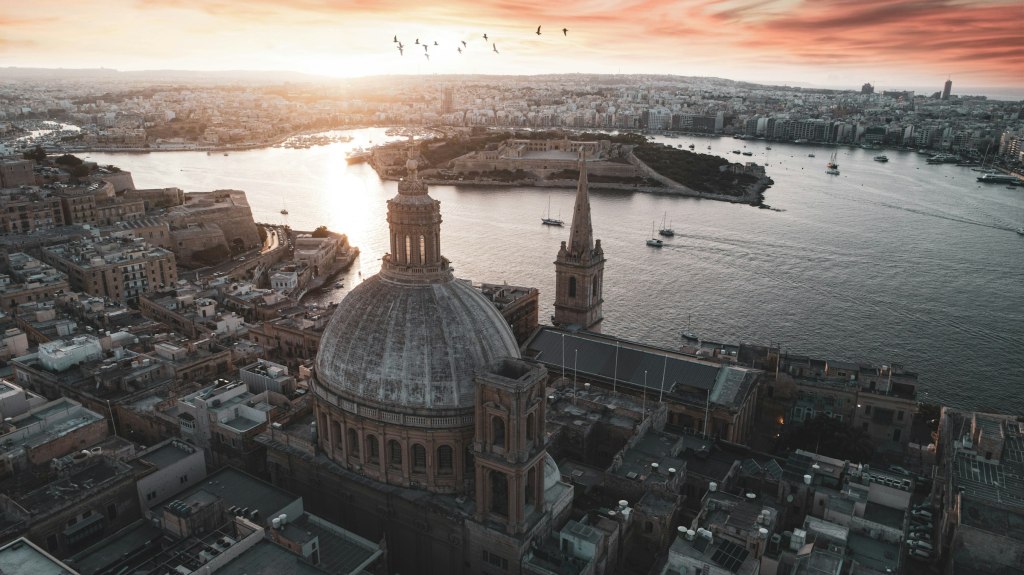
This Valletta travel guide is for anyone who wants Malta’s capital in good light and at a fair price. The city is small enough to cross on foot in half an hour and rich enough to fill a week: honey-colored limestone, balconies painted in harbor greens and blues, a cathedral lined with marble tombstones, and a Michelin-starred table or two. Here is where to stay, what to eat, what the main sights cost, and how to move around for a few euros.
Prices last updated October 2026. Amounts are in euros with a US dollar approximation at about $1.12 to the euro. Rates move with the season and the exchange rate, so treat every figure as a guide, and let official sites and your hotel have the final word.
Valletta travel guide: quick facts
- Currency: euro (EUR), about $1.12. Cards and contactless payments are widely accepted.
- Language: Maltese and English are both official, and English is spoken everywhere visitors go.
- Plugs: Type G (the three-pin British style), 230 volts. Malta drives on the left.
- Time zone: UTC+1 in winter and UTC+2 in summer.
- Getting from the airport: the Airport Direct express bus is about 3 euros a ride (about $3.40), and a Tallinja Explore Flex 7-day card at 27 euros (about $30) includes it. For a taxi or ride-hailing app, apps such as eCabs lock in the fare before you travel.
- Best months: April to early June, and September to October.
When to go
Malta enjoys roughly 3,000 hours of sunshine a year. Spring and early autumn are the gentlest seasons, with warm days, long evenings and a sea that stays above 20 degrees Celsius from June to November. August highs commonly reach 28 to 34 degrees, so plan sightseeing for the morning and keep water close. Winter brings mild days of 12 to 18 degrees, softer hotel rates and a calm city, and Republic Street is a pleasure to stroll without the summer heat.
Where to stay in Valletta
Valletta was founded in 1566 by the Knights of St John and laid out on a grid by the military architect Francesco Laparelli. It has been a UNESCO World Heritage Site since 1980. Staying inside the walls means breakfast on a terrace and the harbor at your feet. Floriana, just beyond the City Gate, offers a leafy garden setting, and Senglea, across the Grand Harbour, has a quieter village rhythm. For more addresses, see our guide to luxury hotels in Malta.
- Osborne Hotel (Valletta): about $100 a night on average, a good-value base in the center.
- The Saint John (Merchant Street): from about $165 to $185 a night, a seventeenth-century limestone building with a courtyard and retro-style rooms.
- Ursulino Valletta: from about $210 a night, an address within the old town walls.
- Cugó Gran Macina (Senglea): from about $270 a night, with 21 suites in a restored fortress and harbor views from every room.
- The Phoenicia Malta (Floriana): from about $370 a night, a 1930s landmark with 132 rooms, gardens and pools a few minutes from the City Gate.
- Iniala Valletta (St Barbara Bastion): from about $370 to $425 a night, a restored bastion property with a spa in the vaults and the two-star ION Harbour on the roof.
Casa Ellul, a nine-suite townhouse on Old Theatre Street, quotes rates on enquiry. On average, five-star hotels run about $233 a night, four-star about $132 and three-star about $102, and January tends to be the softest month. Book ahead for spring and early autumn.
Where to eat and drink
Maltese cooking has a Sicilian cousin and a North African one. Look for stuffat tal-fenek, the slow-braised rabbit stew often called the national dish, and for ftira, the ring-shaped flatbread topped or filled with tomatoes, olives, anchovies and local cheese. Pastizzi, flaky pastries filled with ricotta or peas, are the city’s classic bakery snack and cost very little. Dessert tends toward kannoli, and at Caffè Cordina on Republic Street, open since 1837, a kannol with ricotta is about 4.35 euros ($4.90) and pistachio about 5 euros ($5.60).
For everyday budgeting, a meal at an inexpensive restaurant is about 20 euros ($22), a three-course dinner for two at a mid-range table about 80 euros ($90) without drinks, a cappuccino about 2.80 euros ($3.20) and a pint of draft beer about 5 euros ($5.60).
When the occasion calls for it, the city now holds three starred dining rooms in the 2026 Michelin Guide: ION Harbour with two stars, and Noni and Under Grain with one each. Noni, at 211 Republic Street, serves Tuesday to Saturday from 18:00 to 22:00. Check each restaurant for its current tasting menu and reserve well ahead. For the full picture, read Valletta’s fine dining moment.
What to see, and what it costs
St John’s Co-Cathedral is the city’s masterpiece. The Knights built it between 1573 and 1578, and its floor is a mosaic of marble tombstones for about 375 knights and officers. In the oratory hangs Caravaggio’s The Beheading of Saint John the Baptist, painted in 1608. Admission is 15 euros ($17), which includes an audio guide. Hours are Monday to Saturday from 9:00 to 16:45, with last admission at 16:00, and it is closed Sundays. Cover your shoulders and knees, and wear flat shoes.
The Upper Barrakka Gardens are free and open from 10:00 to 22:00, with the Saluting Battery firing at noon and at 16:00 daily. The terraces date from 1661, and the view over the Grand Harbour and the Three Cities is the best free seat in Malta. Casa Rocca Piccola, at 74 Republic Street, is a family-owned noble house with twelve rooms, garden and wartime shelters cut into the rock. Heritage Malta runs the Grand Master’s Palace, Fort St Elmo and the National War Museum, plus the National Museum of Archaeology; last entry is 30 minutes before closing, and tickets are sold on the Heritage Malta site. For a ready itinerary, see our Valletta in 48 hours plan.
A three-day Valletta itinerary
- Day one, the old city: St John’s Co-Cathedral at opening, a stroll along Republic Street, coffee and kannoli at Caffè Cordina, and sunset at the Upper Barrakka Gardens.
- Day two, fortress and museums: Fort St Elmo in the morning, the Grand Master’s Palace after lunch, then a walk along the sea route around the walls, about 30 minutes.
- Day three, across the water: A ferry or boat to the Three Cities, lunch in Senglea, and a harbor-view dinner back in Valletta.
Getting around
Valletta is a walking city. It sits on a peninsula about a kilometer long and 600 meters wide, though it is steep in places and full of stairs. For the island, a day-route bus ticket is 2 euros ($2.25) in winter, from 18 October 2026 to 12 June 2027, and 2.50 euros ($2.80) in summer, valid for two hours with free transfers. The Explore Adult 7-day card is 25 euros ($28), the Explore Flex 4-day card is 21 euros ($24), and a 12-journey card is 19 euros ($21), shareable and valid for six months. Taxis and apps are easy to find, and horse-drawn karozzin rides are best agreed in advance by price.
Harbor, theater and slower pleasures
Valletta rewards a slow afternoon. A lift connects the Upper Barrakka Gardens to the waterfront below, and a short boat trip around the Grand Harbour shows the bastions from the water, best on a clear day. The Manoel Theatre, one of the city’s historic stages, and the Renzo Piano-designed City Gate frame the old and new sides of the capital. Pause often, order a small coffee, and watch the light move across the limestone.
Day trips
Mdina, the silent walled former capital, glows after the day visitors leave. The island of Gozo makes a relaxed two-day escape, covered in 48 hours in Gozo. Both are easy by car with a driver or by bus.
Practical notes: tipping, SIM and entry
- Tipping: appreciated rather than expected. Rounding up, or leaving around 10 percent for good table service when none is included, is customary.
- SIM and eSIM: regional Europe eSIMs start from about $4 to $5, while a Malta plan with unlimited data is about $27 for 7 days and $69 for 30 days.
- Entry: Malta is in the Schengen area. Citizens of the United States, United Kingdom, Canada and Australia can generally stay up to 90 days in any 180-day period without a visa. The EU Entry/Exit System has been fully operating since April 2026, and ETIAS is not yet operating, so confirm requirements with official EU and Maltese pages before you fly.
- Etiquette: dress modestly for churches, and wear comfortable shoes for the hills and stairs.
Valletta price guide, per person per day
| Style | Stay | Food and drink | Sights and transport | Daily total (about) |
|---|---|---|---|---|
| Budget | $100 to $140 | $35 to $55 | $10 to $25 | $145 to $220 |
| Comfortable | $165 to $270 | $70 to $110 | $20 to $45 | $255 to $425 |
| Luxury | $370 to $425 | $140 to $250 | $25 to $60 | $535 to $735 |
Hotel figures are per room; halve them for two sharing. Totals assume one traveler and exclude flights.
Insider tips
- Visit St John’s Co-Cathedral at opening, when the audio guide and the marble floor have the nave to themselves.
- Take the walk along the sea route around the walls late in the afternoon, when the stone turns gold.
- Sit at the Upper Barrakka Gardens for the noon or 16:00 gun salute.
- Browse South Street and the side lanes for quieter shops than Republic Street.
- Book Noni, ION Harbour and Under Grain several weeks ahead in spring and autumn.
Prices last updated October 2026. Euro figures reflect what was current in autumn 2026 and move with the season and exchange rates. Always confirm admission, hotel and transport costs on the official sites before you travel.

