
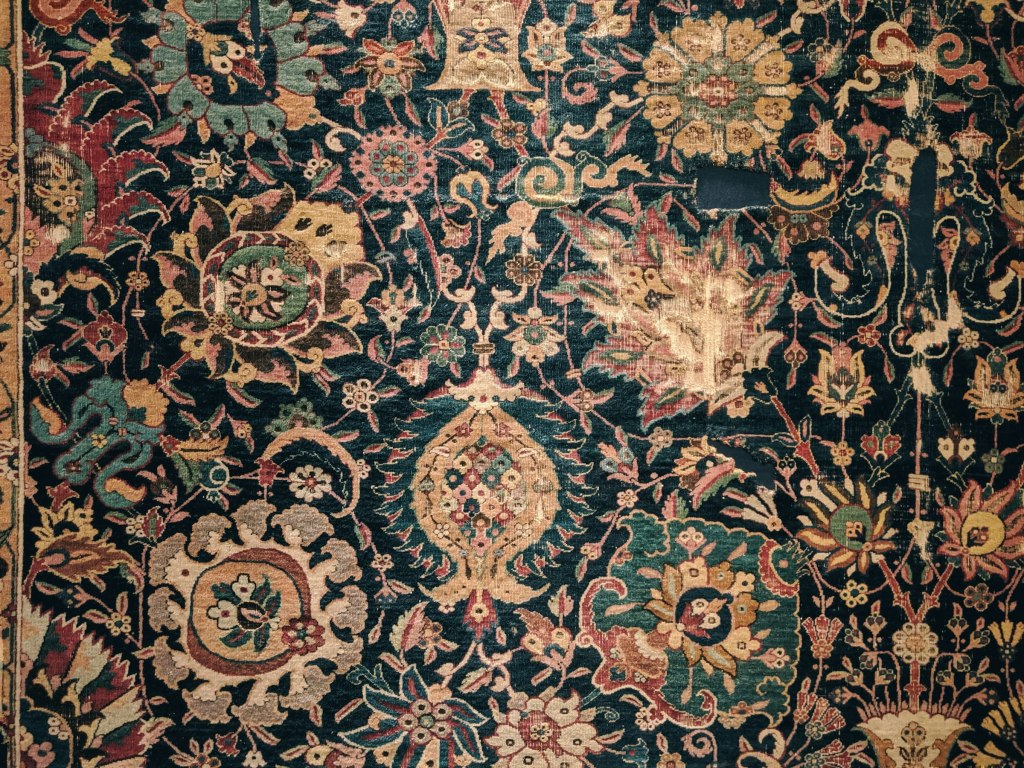
Jordan’s finest souvenirs are made slowly, by hand, often by women working in the villages where the techniques were first learned. Wool spun by hand, stone chipped into tiny tesserae, paper pressed with petals and sumac: Jordanian crafts carry the landscape inside them. This guide follows the makers from Amman to the King’s Highway, with places to watch, learn and take something beautiful home.
Jordanian Crafts Worth Seeking Out
1. Bani Hamida Kilims, Mukawir
In the hills of central Jordan, near the village of Mukawir, Bedouin women of the Bani Hamida Weaving Project spin wool and goat hair by hand and weave on traditional looms. The colors come from nature: indigo for deep blues, pomegranate and mulberry for warm reds and soft purples. The patterns are bold and geometric, the kind of rug that looks right in a desert tent and a city apartment alike.
The weaving center and gallery sit beside the road toward the hilltop castle at Mukawir, and visitors can buy kilims straight from the weavers. Weaving classes can be arranged with advance notice, a rare chance to sit at the loom.
2. Jordan River Foundation Showroom, Amman
If the drive south doesn’t fit your plans, the Jordan River Foundation, established in 1995, sells Bani Hamida rugs and other well-made crafts at its Amman showroom, with proceeds supporting its community work. Look for the handloomed rugs of pure natural wool sold under its Jordan River Designs label. Fixed prices make for an easy, pleasant visit.
3. Mosaics in Madaba
About 30 kilometers southwest of Amman, Madaba is Jordan’s city of mosaics. Begin at the Greek Orthodox Church of St George, where the famous Madaba Map, a sixth- or seventh-century picture of the Holy Land made from more than two million pieces of colored stone, covers the floor. Then walk to the Madaba Archaeological Park, home to the Madaba Institute for Mosaic Art and Restoration, where the craft is taught and conserved.
Around town, workshops let you watch the patient art of setting stones. Lawrence Arts & Crafts is a private workshop where you can see mosaic-laying in progress and buy a copy of the Madaba Map or a larger original piece, while the Haret Jdoudna complex offers mosaics, ceramics and textiles beside its well-loved restaurant. In Amman, Mosaic House offers mosaic classes by booking.
4. Handmade Paper at Iraq Al-Amir
West of Amman, in the village of Iraq Al-Amir, a women’s cooperative founded in 1993 by the Noor Al-Hussein Foundation works out of restored Ottoman-era houses. Paper is made by hand from natural local materials, and guests can join a workshop to press palm leaves, flowers, sumac and tea into their own sheets. There are handlooms and a pottery studio too, and a gift shop filled with the cooperative’s work. Cooking classes featuring musakhan and other classic dishes round out a lovely half day.
5. Painted Ostrich Eggs in Azraq
In the eastern desert near Azraq, artisans trained by the Royal Society for the Conservation of Nature dot-paint delicate designs onto ostrich eggs, a craft linked to the nearby Shaumari Wildlife Reserve. At the Azraq Wetland Reserve, visitors can try the technique in the workshop. The finished eggs, glowing with fine patterns, are some of the most distinctive keepsakes in the country.
6. Wild Jordan Center, Amman
On Othman Bin Afan Street, overlooking the old city and the Citadel, the Wild Jordan Center is owned by the Royal Society for the Conservation of Nature. Its Nature Shop gathers crafts and natural products from Jordan’s reserves, with proceeds supporting the families who live in and around them. Look for silver jewelry, herbs, teas and jams, then settle into the café for the view.
7. Calligraphy Lessons
For something to take home in your own hand, the Deewan Institute for Languages and Cultural Studies in Amman teaches the Diwani and Ruq’ah scripts with a bamboo pen. In the north, the House of Calligraphy at the Ajloun Forest Reserve offers lessons by appointment and sells beautiful script-decorated stationery.
Tips for Buying Jordanian Crafts
- Buy from cooperatives and workshops where you can, and ask about the maker. Many pieces come with a lovely story.
- Book classes and weaving sessions ahead, since many are arranged by appointment.
- Ask about shipping for rugs and larger mosaics. Many workshops can arrange it.
- Carry some cash for village workshops and smaller studios.
A kilim from Bani Hamida or a small mosaic from Madaba will outlast any trip. Each one holds a little of Jordan’s patience and generosity, and every time you look at it, you’ll be back on the King’s Highway with the hills turning gold.


Leave a Reply