
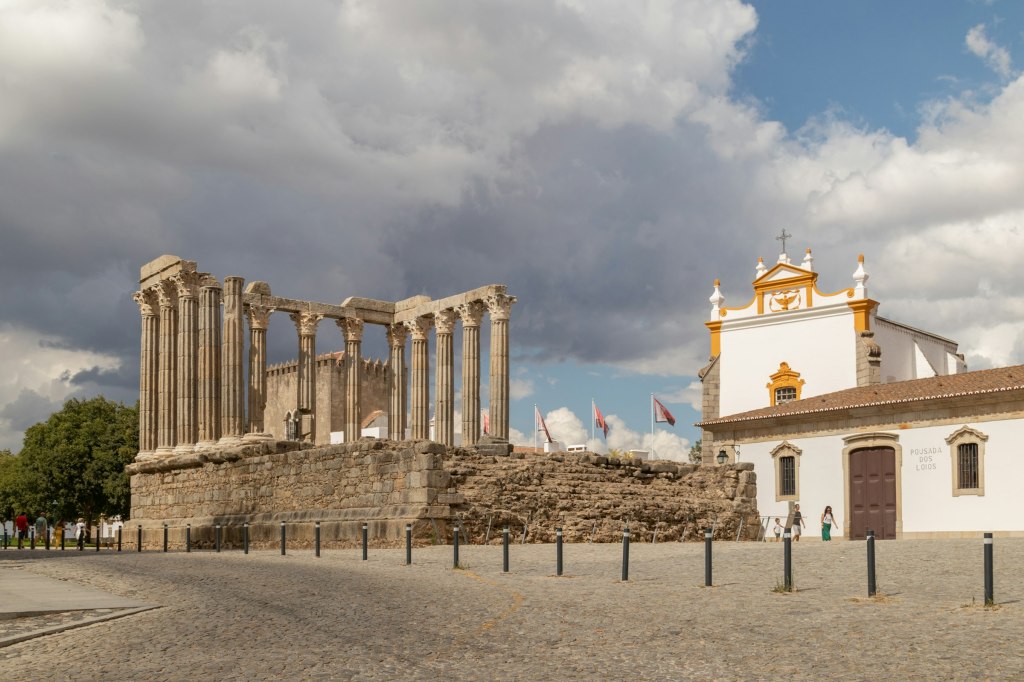
A day in Évora is an easy trade: under two hours from Lisbon, one walkable hilltop city, and two thousand years of history in a few square blocks. The historic center is a UNESCO World Heritage Site, and this itinerary threads together a Roman temple, a cathedral, an aqueduct, a chapel lined with bones and the flavors of the Alentejo.
Morning: the Chapel of Bones
Begin at the Church of São Francisco, where the Chapel of Bones is lined with the remains of thousands of people. An inscription at the entrance, in the spirit of quiet reflection, translates roughly as “We bones that are here, for yours we wait.” It is solemn, and strangely beautiful.
Next door, the public gardens hold romantic “ruins” built in the nineteenth century from stones gathered from other monuments. A good place for a first coffee and a pastry such as queijada de Évora, a small cheese tart typical of the town.
Midday: the Roman Temple and the Cathedral
Climb to the highest point of the old town. The Roman Temple, popularly called the Temple of Diana, dates to the second century, and its granite and marble columns glow in afternoon light. You admire it from the outside, which suits a photograph.
Across the plaza stands the cathedral, often described as one of the largest medieval cathedrals in Portugal. Its terrace gives wide views over rooftops and cork-oak country, and a small museum of religious art rewards a slow visit.
Afternoon and evening: Alentejo flavors in Évora
Wander toward Rua do Cano, where a stretch of the sixteenth-century aqueduct runs through the town and houses tuck between its arches. Then settle in for dinner. The Alentejo is known for porco preto, the dark-haired local pig, and for generous red wines; restaurants such as O Templo and Botequim da Mouraria are often recommended for tasting both.
Getting to Évora
By car, the drive from Lisbon takes roughly an hour, and a direct bus from the Oriente station takes under two hours. An early start leaves time for everything above. To stay longer in the capital before or after, see our guide to luxury hotels in Lisbon, and for tilework you’ll recognize on Évora’s walls, the azulejos in Lisbon guide is a lovely companion.

