
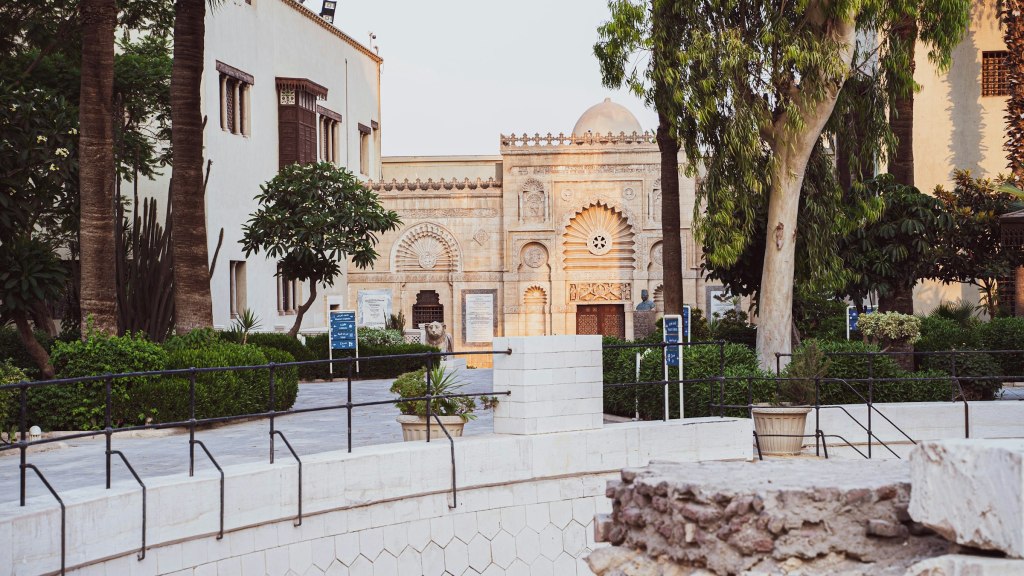
A day in Coptic Cairo is one of the most rewarding ways to meet the city’s older layers. Inside the old Roman fortress district, churches, a synagogue and a first-rate museum sit within a few minutes’ walk of each other, and the lanes between them are quiet in a way the rest of Cairo rarely is. Here is how to spend a calm morning and early afternoon among them.
Arriving in Coptic Cairo
The district has its own metro stop, Mar Girgis, which makes it one of the few major sights in Cairo you can reach by train. Go on a weekday morning if you can. The light is soft, the courtyards are calm, and you can linger in each space without feeling rushed. As of this writing, the churches in the complex are generally open from 8 a.m. to 4 p.m., so a morning start gives you the full day.
The Hanging Church and Saint Sergius
Begin with the Hanging Church, known in Arabic as El Moallaqa. It’s called “hanging” because it rests above the gatehouse of the Roman fortress of Babylon. A church is believed to have been established on the site in the late seventh century, and it’s often described as one of Egypt’s earliest basilica-style churches. Inside, look for the collection of roughly 110 icons, most painted on ebony, some inlaid with ivory. The oldest are said to date to the eighth century.
A short walk away, the Church of Saint Sergius, also called Abu Serga, goes back further still. It’s considered among the oldest churches in Egypt, with origins in the fourth century. Its crypt, about ten meters below the floor, is traditionally associated with the Holy Family’s rest during their flight into Egypt. Even for visitors who come mainly for the architecture, the stillness down there is memorable.
Ben Ezra Synagogue and the round church of Mar Girgis
The Ben Ezra Synagogue is a two-story basilica-style building. It began life as a Coptic church before passing into Jewish use, and the structure you see today dates to 1892. It now functions as a museum, and tradition links the area to the story of the infant Moses. The upper gallery, once used by women worshippers, is a quiet place to take in the proportions.
Mar Girgis, the Church of Saint George, is one of the few round churches in Egypt. Stained glass and rich woodwork give it a warm glow, and it rises over the remains of a Roman tower. Do pause at the Church of Saint Barbara too, with its fifth-century origins and layers of restoration.
The Coptic Museum
Save the museum for after lunch, when your eye has been trained by the churches. Its collection runs to more than 1,600 pieces: icons, glass, metalwork, woodwork and textiles, plus manuscripts such as medieval Bibles written on deerskin and sixth-century papyrus. As of this writing, the museum opens from 9 a.m. to 5 p.m. and accepts card payments, but it’s wise to confirm before you go.
Planning your day in Coptic Cairo
- Dress modestly, with shoulders and knees covered, and carry a light scarf.
- Allow three to four hours for the churches and one more for the museum.
- Move at the pace of the lanes. Conversation drops to a murmur here, and visitors tend to follow.
- Pair the district with a second Cairo chapter, such as Al-Muizz Street and its Mamluk courtyards, on another morning.
For a broader view of what to see across the country, read a day at the Grand Egyptian Museum beside the pyramids. Coptic Cairo is the quieter counterpart, and often the part of the trip people remember most fondly.

