
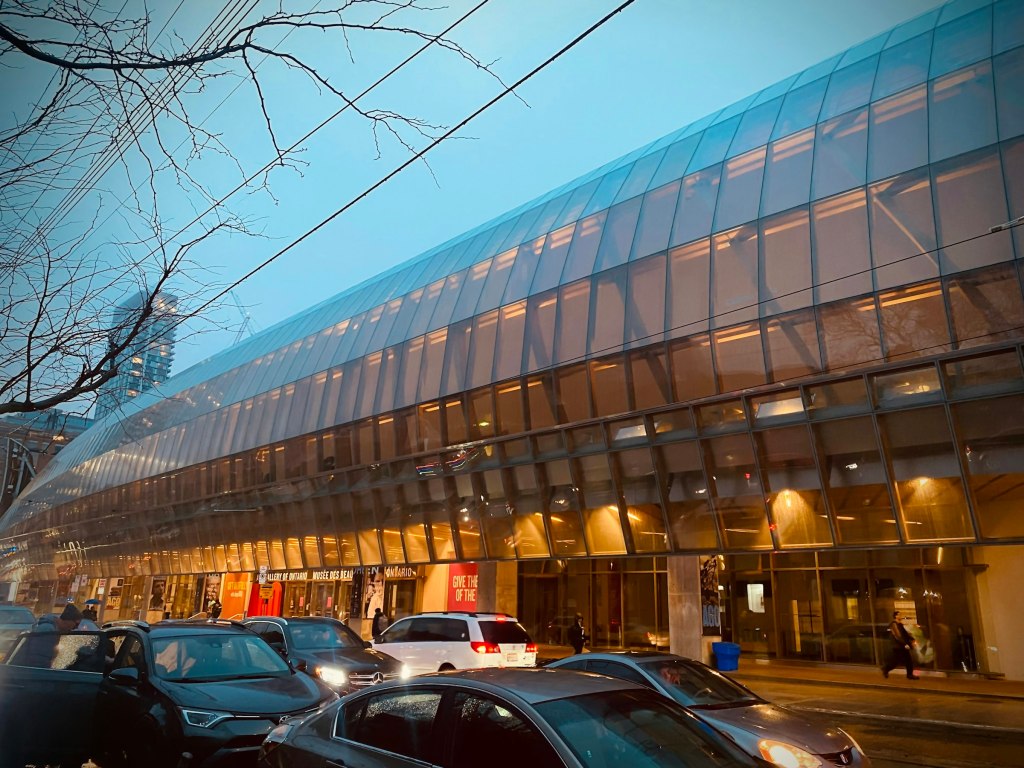
Toronto museums reward a single, well-paced day. Three of them, the Art Gallery of Ontario, the Royal Ontario Museum and the Aga Khan Museum, also happen to be three of the most striking buildings in the city, each the work of a celebrated architect. Seeing them in sequence is a lesson in how a museum can shape the way you look: warm Douglas fir downtown, faceted aluminum and glass on Bloor Street, and soft white stone in a garden to the north.
Morning: The Art Gallery of Ontario
Start on Dundas Street at the Art Gallery of Ontario, which reopened in November 2008 after a transformation led by Frank Gehry. The project more than doubled the gallery’s exhibition space and gave it a new face: Galleria Italia, a long, light-filled promenade of Douglas fir and glass running across the front of the building. Inside, a sculptural wooden staircase rises from the main entry hall, and it is worth lingering over for its curves and craftsmanship.
The collection is wide, but the Canadian rooms are a highlight. The Thomson Collection, a gift from Kenneth Thomson of more than 2,000 works, includes paintings by Tom Thomson, Lawren Harris, Cornelius Krieghoff and Paul Kane. Look for the northern landscapes, painted in deep greens and autumn reds. Before you leave, step out back to The Grange, the restored Georgian house from 1817 that was the gallery’s first home.
Midday: The Royal Ontario Museum
A short ride north brings you to the Royal Ontario Museum at Bloor Street and Queen’s Park. Its Michael Lee-Chin Crystal, designed by Daniel Libeskind and opened in June 2007, juts out toward the street in sharp, angled planes of aluminum and glass. It is one of Toronto’s most photographed buildings, and the play of light inside the galleries changes all day.
The ROM is a museum of both art and natural history, so pick a theme and follow it. The dinosaur galleries are a joy at any age, while the galleries of world cultures, textiles and costume reward a slower look. Pause for lunch nearby in Yorkville, then head north.
Afternoon: The Aga Khan Museum
The Aga Khan Museum, at 77 Wynford Drive, opened in September 2014 in a building by the Japanese architect Fumihiko Maki. It feels calm from the moment you arrive. The museum shares a ten-hectare landscaped park, designed by Vladimir Djurovic, with the Ismaili Centre by Charles Correa, and reflecting pools sit between the two buildings.
The permanent collection of more than 1,000 objects spans over a millennium and a vast geography, from the Iberian Peninsula to China. Expect illuminated manuscripts and paintings on paper, ceramics, metalwork, carved ivory, textiles and carpets, glass and rock crystal. Many pieces are small and exquisitely detailed, so give yourself time. Afterward, walk the garden paths as the light softens.
Tips for a Day of Toronto Museums
- Start early. Arriving close to opening time at the AGO gives you the galleries at their quietest.
- Plan your route. The AGO and ROM are both central, while the Aga Khan Museum is a short drive northeast, so it suits the afternoon.
- Check for timed tickets. Special exhibitions at all three may need advance booking, and hours can vary by season, so confirm details as of your visit.
- Choose one focus per museum. Canadian painting at the AGO, a single collection at the ROM and the manuscripts at the Aga Khan Museum make for a satisfying, unhurried day.
- Linger over the architecture. Each building is a destination in itself, inside and out.
By evening, you will have crossed centuries and continents without leaving the city. Toronto museums do that beautifully, and they make a fine argument for slowing down.

