
A day in Sheki feels like stepping into the margins of an illuminated manuscript. The town sits in a green valley of the Greater Caucasus in northern Azerbaijan, its red-tiled roofs climbing toward forested slopes, and its old heart was inscribed on the UNESCO World Heritage List in 2019 as the Historic Centre of Sheki with the Khan’s Palace. UNESCO describes it as an 18th-century trade town known for its silk farming, and the silk story still threads through everything you will see, taste and buy.
Morning: The Khan’s Palace in Sheki
Arrive when the gates open and the light is soft. The summer palace was built in 1762 for Muhammad Hasan Khan, a two-story brick pavilion under a wooden hipped roof, set behind a pool and shaded by venerable plane trees. From the outside it is graceful. Inside, it is astonishing.
The windows are made in the shebeke technique: small pieces of colored glass fitted into wooden latticework that is traditionally assembled without nails or glue, with thousands of fragments in a single square meter. When the sun moves, the rooms fill with pools of ruby, cobalt and amber light that slide slowly across the floor. The walls carry painted frescoes of hunting and battle scenes alongside floral and geometric ornament. Stand still for a few minutes; the colors change as you watch.
Tip: photography rules inside the palace can vary, so ask at the entrance before raising your camera.
Late Morning: Workshops and the Old Town
Walk downhill through the old quarter, where stone houses with deep wooden balconies line the lanes. Sheki is a working craft town, and small workshops sell copper and bronze vessels, wood carving, handwoven carpets and shebeke panels made by local masters. Watching a craftsman press tiny glass pieces into a carved frame is the perfect sequel to the palace.
Look, too, for kelaghayi, the fine silk headscarves whose making and symbolism UNESCO recognized as intangible heritage in 2014. Sheki historically supplied the silk, while the nearby village of Basqal became renowned for weaving and block-printing the scarves with natural dyes. A kelaghayi folds into almost nothing and makes an exquisite keepsake.
Lunch: The Upper Caravanserai
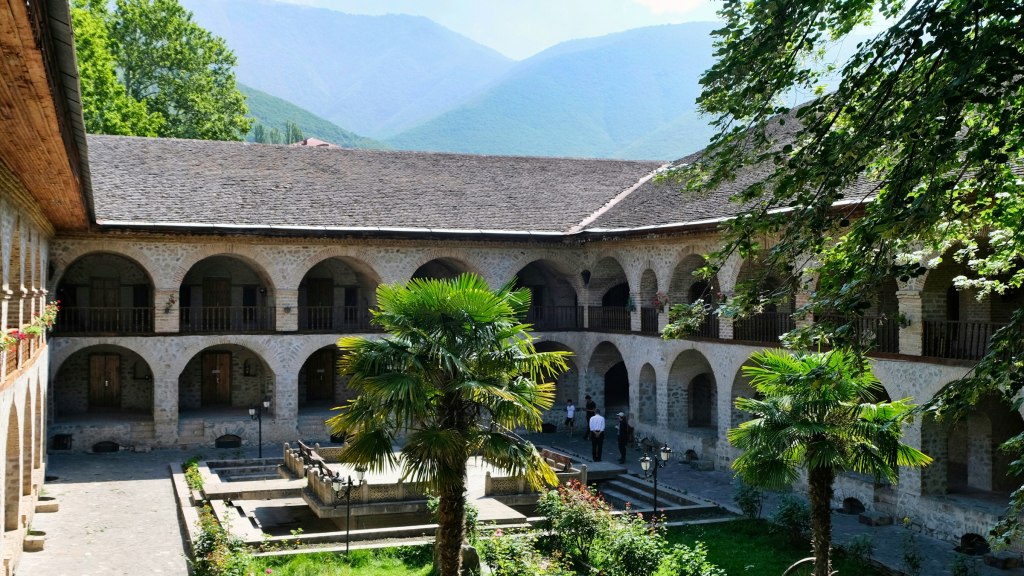
Two caravanserais survive from the town’s trading centuries, the Upper and the Lower. The Upper Caravanserai, with its galleries of arched rooms around a broad courtyard, now operates as a hotel and restaurant, which means you can lunch where Silk Road merchants once unloaded their bales. Order something slow and local, and ask for tea in the courtyard afterward. If you can, book a night here; the courtyard after dark is wonderfully atmospheric.
Afternoon: The Khan Mosque and the Church of Kish
The 17th-century Sheki Khan Mosque complex, with its mosque, minaret, madrasa and bathhouse, still serves as a place of worship and rewards a respectful, unhurried visit. Then drive a few kilometers up the valley to Kish, where a small stone church dated to the early centuries of the Common Era stands among village houses and walnut trees. The contrast between the jeweled palace and this quiet, honey-colored chapel is part of what makes a day here so rich.
Before You Leave: Sheki Halva
No one leaves Sheki without a box of halva. This is not the crumbly sesame confection you may know, but a lacy lattice of thin pastry layered with walnuts, perfumed with cardamom and soaked in syrup, cut into diamonds and sold all over town. Buy it fresh, eat a piece on the spot, and carry the rest home very carefully.
Practical Tips
- Spring and early autumn bring mild weather and the greenest hills.
- Comfortable shoes help; the old town lanes slope steadily.
- Dress modestly for the mosque and carry a light scarf.
- Opening hours change seasonally, so confirm times locally, as of this writing.
Sheki rewards those who slow down. Give it a full day, or better still a night, and the colored light of the palace will stay with you long after you have gone.

