
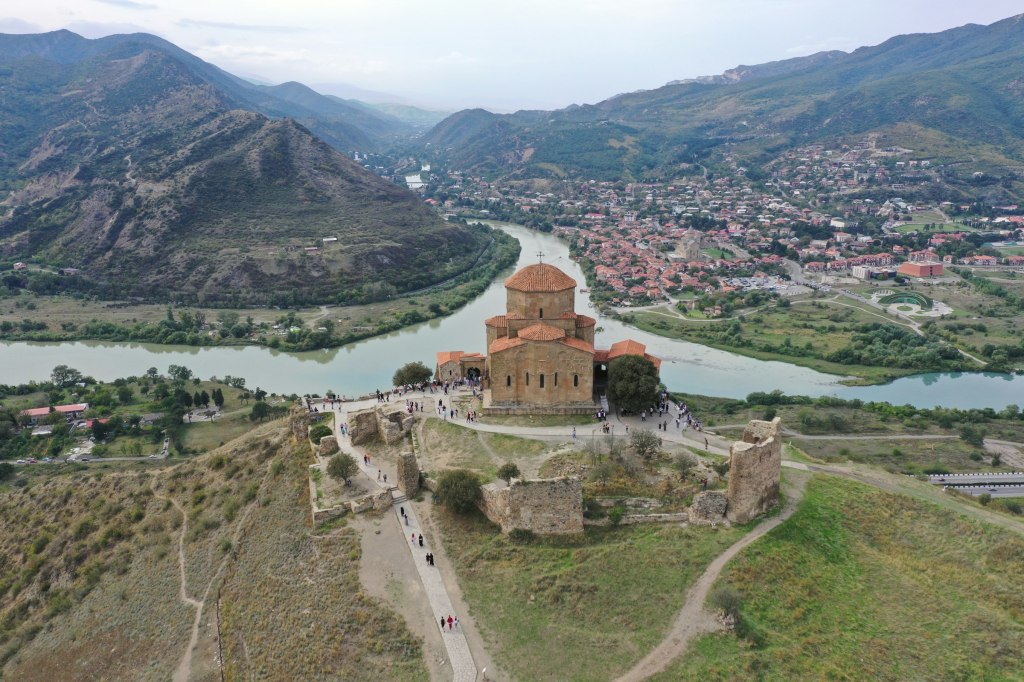
A day in Mtskheta is a day spent at the very beginning of Georgia’s story. This small town, a short drive north of Tbilisi, was the capital of the ancient eastern kingdom of Kartli from the 3rd century BC to the 5th century AD, and it was here, in the 4th century, that Christianity was proclaimed the official religion. The capital later moved to Tbilisi, yet Mtskheta never lost its importance. It remains the seat of the Georgian Orthodox Church, and its Historical Monuments have been on the UNESCO World Heritage List since 1994.
What makes the town so rewarding is its scale. Three great sacred sites, a walkable old quarter and a river view that has barely changed in centuries all fit comfortably into a single unhurried day.
Morning at Jvari Monastery
Begin on the hilltop opposite town, at Jvari, the Holy Cross Monastery. The 6th-century church stands on a rocky spur above the confluence of the Mtkvari and Aragvi rivers, and UNESCO describes the site as among the most sacred places in Georgia. The building is compact and perfectly proportioned, a domed tetraconch of pale stone whose design influenced church architecture across the region for generations.
Arrive early, when the light is low and the wind carries up from the valley. From the terrace you can watch the two rivers, one darker and one paler, braid together below, with the rooftops and cathedral of Mtskheta laid out on the far bank. It is one of the great views in the Caucasus, and a fitting overture for what follows.
Midday at Svetitskhoveli Cathedral
Down in the heart of town, Svetitskhoveli Cathedral rises behind its fortified walls. The present building dates from the 11th century and was raised on the site of earlier churches going back to the 5th century. Its cruciform plan is crowned by a tall cupola over the crossing, and the exterior is covered in sculpted decoration added across many periods, so it rewards a slow walk all the way around.
Inside, the scale is cathedral-grand and the atmosphere hushed. Fragments of medieval wall paintings glow faintly in the candlelight. According to a cherished tradition, the robe of Christ is believed to rest beneath the cathedral, and the name Svetitskhoveli is usually translated as the “living pillar.” Take your time here. Many visitors find a quiet bench in the courtyard simply to sit with the place before moving on.
Afternoon at Samtavro Monastery
A short stroll north brings you to Samtavro, a gentler and more intimate complex. Its small domed church was first built in the 4th century and is linked to Saint Nino, the woman credited with bringing Christianity to Georgia. The main church dates to the early 11th century and holds the grave of King Mirian III, the ruler of Iberia who made Christianity the state religion, along with his queen, Nana. The gardens are carefully tended and peaceful, and the nuns’ quiet routines set the rhythm of the afternoon.
Late Afternoon in the Old Town
Leave an hour for the lanes around Svetitskhoveli, where small shops sell carpets, icons, ceramics and drinking horns. Stop for churchkhela, the strings of walnuts dipped in thickened grape juice that hang like candles in the stalls, and a glass of fresh fruit juice. As the sun drops, look back up at Jvari on its ridge, now catching the last warm light.
Tips for a Day in Mtskheta
- Visit Jvari first. It sits on a separate hill across the river, so a driver or taxi makes the morning simplest.
- Dress modestly for all three sites. Women customarily cover their hair, and scarves and wraps are often provided at the entrance.
- Photography is not permitted inside Samtavro, so enjoy it with your eyes and save the camera for the gardens.
- Services take place throughout the day. Visitors are welcome to stand quietly at the back and listen to the chanting.
- Pair the visit with lunch in Tbilisi or a countryside table on the way back, and check opening details locally as of this writing.
By evening you’ll have walked through seventeen centuries of Georgian devotion in a few kilometers. Few places hold so much meaning so lightly, and fewer still are this easy to love.

