
An hour’s drive north of Amman, the hills soften and turn green, and the ancient city of Jerash rises from the valley in honey-colored stone. Known to the Romans as Gerasa, it is a remarkably well-preserved Roman provincial city, a place where you can still walk the main street, stand inside the theaters and follow the ruts of chariot wheels worn into the paving. It’s a day of columns, temples and big skies, and in summer it becomes a stage.
A Brief History of the Ancient City of Jerash
People have lived in this valley for more than 6,500 years. In 63 BC the Roman general Pompey brought the region under Rome, and Gerasa became one of the Decapolis, a league of ten cities on the eastern edge of the empire. Its golden age came under Roman rule, when trade brought wealth and the city filled with temples, theaters and plazas. In 129 AD the emperor Hadrian came to visit, and the people of Gerasa built a triumphal arch in his honor.
Hadrian’s Arch and the Hippodrome
That arch still greets you at the southern approach. It was meant to become the city’s main southern gate as Gerasa expanded, and its three openings frame the hills behind in a way that feels designed for a camera. Just beyond lies the Hippodrome, about 245 meters long and 52 meters wide, where some 15,000 spectators once watched chariot races. As of this writing, the Roman Army and Chariot Experience stages lively shows here with legionnaires, mock gladiator bouts and chariots, a cheerful way to imagine the arena full.
The Oval Plaza and the Cardo
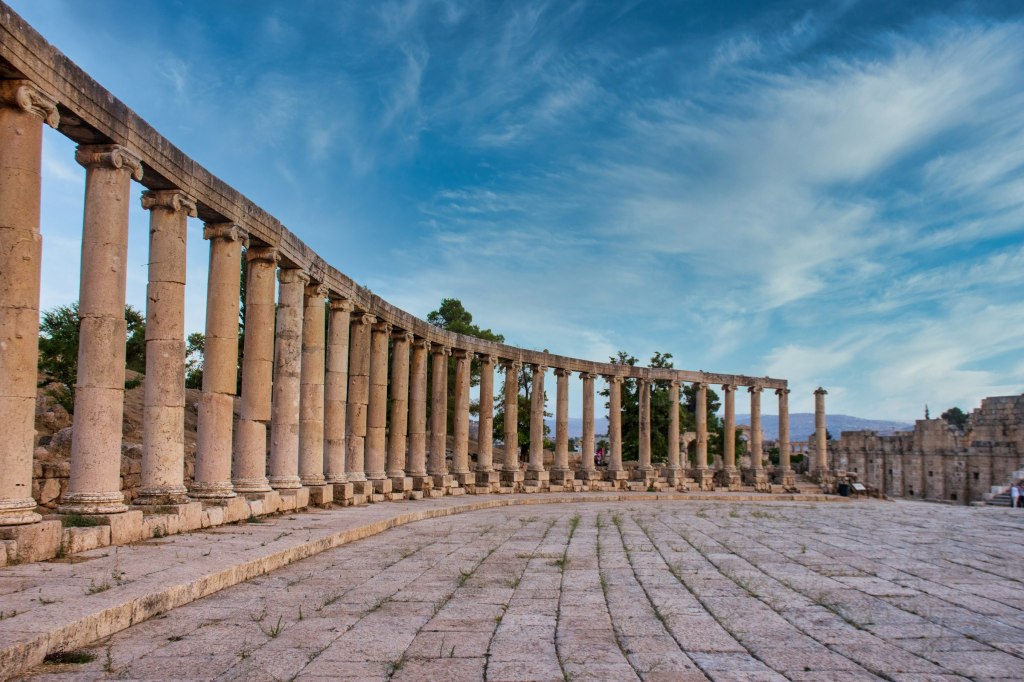
Walk on and the city opens into the Oval Plaza, perhaps Jerash’s most memorable space. It measures roughly 90 by 80 meters and is ringed by a colonnade of Ionic columns from the first century AD, their curve giving the whole plaza a sense of movement. Stand at the center in late afternoon, when the stone warms to gold.
From here the Cardo Maximus, the colonnaded main street, runs north through the city for about 800 meters. Look down as you walk. The paving still carries the grooves of chariot wheels. Side streets climb toward the temples and fountains, and it’s easy to lose an hour simply following the columns.
Temples, Theaters and a Museum
Above the Cardo, the Temple of Artemis honors the city’s patron goddess, its tall columns still standing against the sky. The South Theatre, built between 90 and 92 AD under Domitian, seats more than 3,000 people and still hosts concerts and productions. The smaller North Theatre, built in 165 AD and enlarged in 235 AD, has an intimacy all its own.
Before leaving, step into the Jerash Archaeological Museum, founded in 1923 in a vault of the Artemis Temple courtyard. Coins, statuary and sarcophagi from the excavations help the ruins outside make sense.
The Jerash Festival for Culture and Arts
Each summer, usually from late July into early August, the old city comes alive with the Jerash Festival for Culture and Arts. Music, theater, poetry, dance and handicrafts fill the ancient spaces, and the South and North Theatres host the headline evenings under the stars.
The 2026 edition was a milestone: the 40th festival ran from July 22 to August 2 under the theme “A Legacy That Endures… Generations Meet.” It brought 213 Jordanian, Arab and international events to more than 15 venues across the site, with performers from around 20 countries. For the first time the Hippodrome became a festival stage, and a new Gerasa Market showcased handicrafts, creative industries and family activities. Tickets were sold through the official eTathkara platform, and it’s wise to watch for next year’s program from early summer.
Tips for Your Visit
- Arrive in the morning to enjoy the site in soft light and cool air, then return to the Oval Plaza for the golden hour.
- Wear comfortable shoes; the paving is ancient and the site is large.
- Bring a hat and water in the warmer months.
- Pair Jerash with a late lunch in the green hills nearby, or continue on to Ajloun for its forested landscape.
- If you’re visiting in summer, check the festival schedule and book an evening at the South Theatre.
Jerash is a place that asks for an unhurried day. Walk its streets, sit on the theater steps and watch the shadows move along the columns. Few places make the Roman world feel so near, and so welcoming.


Leave a Reply