
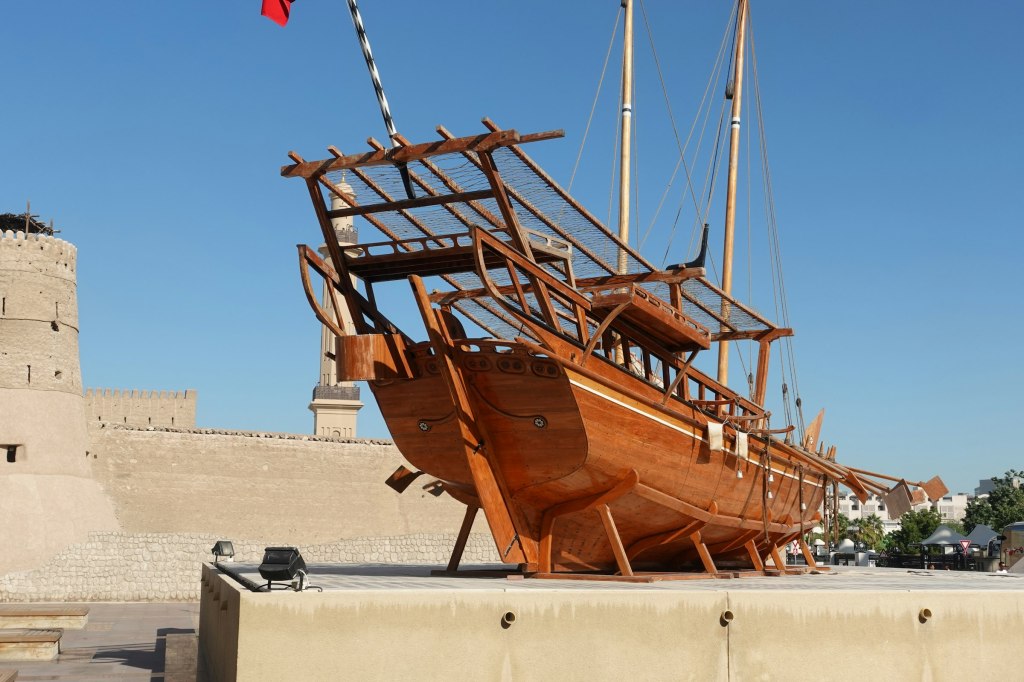
For centuries, Bahrain’s fortune lay on the seabed. Divers left each summer on wooden dhows, holding their breath over the oyster banks while merchants waited ashore to weigh and grade the catch. Bahrain’s Pearling Path in Muharraq keeps that story alive, and it does so in the most human way possible: through the houses, courtyards and gathering rooms of the people who lived it.
Inscribed on the UNESCO World Heritage List in 2012 under the title “Pearling, Testimony of an Island Economy,” the site is often described as the last complete example of a traditional pearling economy left in the world. It’s also the only one of Bahrain’s three World Heritage Sites you can walk from end to end.
The Story Behind Bahrain’s Pearling Path
Pearl diving in these waters reaches back many centuries, and it remained the island’s great industry until the 1930s. Muharraq, Bahrain’s capital from 1810 to 1923, was the heart of it all. Captains, divers, traders and craftsmen lived side by side in its narrow lanes, and their homes reflect every rung of a finely tuned economy.
The UNESCO property brings these threads together. It includes 17 buildings in the historic quarter of Muharraq, three offshore oyster beds in the island’s northern waters, and a stretch of seashore with Bu Maher Fort at the southern tip of Muharraq, where the diving fleet once set out.
Walking the Trail
The path runs about 3.5 kilometers, from the Bu Maher seashore to the Siyadi complex in the center of Muharraq. At a comfortable pace it takes around two to two and a half hours, longer if you linger in the houses, and you will want to. Walking the path itself is free.
Begin at the visitor and experience center near Suq Al Qaysariyyah, designed by the Swiss architect Valerio Olgiati. Its spare, shaded concrete architecture is a cool, contemplative counterpoint to the old lanes beyond, and it’s an elegant introduction to what lies ahead. As of this writing, the center opens from 10 a.m. to 6 p.m., Wednesday through Monday.
Five Stops to Savor
- Bu Maher Fort. The seafront fort at Muharraq’s southern tip marked the departure point for the fleet. As of this writing, it can be reached by a short boat ride from the Bahrain National Museum, a lovely way to arrive as the divers once left.
- Beit Fakhro. The home of a pearl trader, with rooms that hint at the dealing and hospitality that kept the economy moving.
- Beit Al-Alawi. Once home to a provisions trader, a reminder that every voyage depended on rice, dates and fresh water loaded before the season began.
- Bait Al-Jalahma. Look for its central hafiz, a gathering space at the heart of the house, where talk of weather, prices and the season’s catch would have filled the evenings.
- The Siyadi complex. The trail ends among the Siyadi family’s majlis and mosque, a graceful close that speaks to the prosperity pearls once brought to Muharraq.
Small Pleasures Along the Way
Part of the beauty of the walk is what happens between the landmarks. Restored squares open suddenly between the lanes, wooden doors glow in the late-afternoon sun, and the scent of cardamom drifts out of small cafes. When your feet need a rest, stop for a glass of karak tea, and before you leave, pick up a tin of halwa from Showaiter, a family of sweet shops near the Muharraq souq. The saffron-and-cashew red version is a fitting souvenir of a town built on generosity.
Tips for the Visit
- Go in the cooler months, roughly November to March, or start in the late afternoon for softer light.
- Wear comfortable shoes and dress modestly, as the trail runs through a living neighborhood.
- Check opening times for individual houses before you set out, since hours can vary.
- Pair the walk with the Bahrain National Museum to see the pearling story in its wider context.
Walking the Pearling Path is less a tour than a conversation with the past. By the time you reach the Siyadi complex, the old lanes of Muharraq feel less like a museum and more like a neighborhood that still remembers the sea.

