
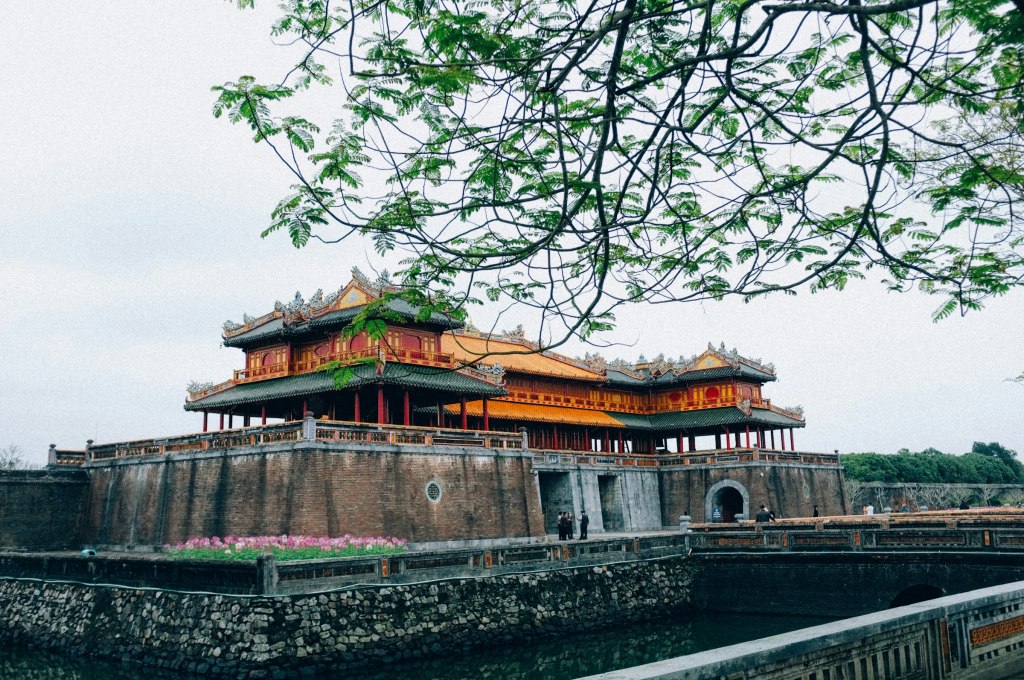
Hue moves at the pace of its river. Spend a day in Hue and you’ll find a city that holds its history lightly: moats softened by lotus, royal tombs set among pine hills, and a pagoda bell that carries across the Perfume River at dusk. From 1802 to 1945 this was the seat of the Nguyen dynasty, the last of Vietnam’s royal houses, and the city still feels shaped by that long, elegant season.
In 1993, the Complex of Hue Monuments became the first site in Vietnam inscribed on the UNESCO World Heritage List. Here is how to see its finest pieces in one unhurried day.
Where to Stay: Azerai La Residence, Hue
Begin and end at Azerai La Residence, a former French governor’s residence from the 1930s that now houses one of the city’s most graceful hotels. It sits on the banks of the Perfume River, facing toward the Imperial City, and keeps its Art Deco lines: high ceilings, geometric details, terraces that catch the river breeze. There is a saltwater pool in the riverside gardens, a spa, and Le Parfum, the hotel’s restaurant, for a quiet dinner after a long day of looking.
Morning: The Imperial City of Hue
Go early, when mist still rises from the moat. Construction of the citadel began in 1805 under Emperor Gia Long and was completed in 1832 under Emperor Minh Mang, whose reign from 1820 to 1840 is remembered as the dynasty’s high point. Inside the outer walls lies the Imperial City, and within it the Forbidden City, once reserved for the emperor and his family.
Walk slowly. The scale is generous, the gardens are calm, and the details reward attention: glazed tiles in imperial yellow, dragons coiled along rooflines, ceramic mosaics glinting on gateways. Allow at least two to three hours.
Midday: Court Music at Duyet Thi Duong
Before you leave the citadel, look for a performance at Duyet Thi Duong, a theater built for royal entertainment under the Nguyen dynasty and often described as the first of its kind in the country. Nha nhac, the refined court music of Hue, was recognized by UNESCO in 2003. Its ensembles bring together drums, strings and wind instruments in pieces once played for coronations, ceremonies and royal banquets. Even a short program, as of this writing, offers a vivid sense of how sound once framed life at court.
Afternoon: Three Royal Tombs
The Nguyen emperors planned their tombs with the same care they gave their palaces, choosing sites for their harmony of water, hill and sky. Seven tomb complexes honor nine emperors. Three make a beautiful afternoon:
- The Tomb of Minh Mang, built between 1840 and 1843, is laid out along a long axis of courtyards, pavilions and lakes, with around 40 structures arranged in calm symmetry.
- The Tomb of Tu Duc, built between 1864 and 1867, feels like a poet’s retreat, with a lotus lake, a pavilion over the water and 50 structures enclosed within a long wall. Tu Duc used it as a pleasure garden during his lifetime.
- The Tomb of Khai Dinh, built between 1920 and 1931, is the smallest of the three and the most surprising, blending Vietnamese and Western architecture. Its interior glitters with mosaics of porcelain and glass.
A car and driver for the afternoon is the easiest way to move between them, since the tombs are spread across the hills south of the city.
Late Afternoon: Thien Mu Pagoda
Finish with the city’s most beloved landmark. Thien Mu Pagoda stands on a low hill above the Perfume River, and its seven-story Phuoc Duyen tower, built in the 1840s under Emperor Thieu Tri, has become a symbol of Hue itself. The grounds are peaceful, shaded and tended with care. Its great bell is said to be heard 10 kilometers away, and when it sounds in the late light it feels like the right way to end the day.
Evening: On the Perfume River
Return along the river to your hotel. Some evening boat trips on the Perfume River include performances of traditional music, a soft echo of what you heard at the citadel. Then dinner, a last look at the water, and sleep.
Tips for a Day in Hue
- Start at the citadel at opening time for cooler air and gentle light.
- Dress with shoulders and knees covered for the pagoda and tombs.
- Comfortable walking shoes make the citadel’s wide courtyards a pleasure.
- Check the current performance schedule at Duyet Thi Duong a day ahead.

